
AS01 and Matrix-M are two of the most promising new saponin adjuvant systems in the vaccine industry. While they share some compositional overlap (both contain saponins from the Quillaja saponaria tree), they differ in structure, mechanism of action, and application scenarios. Below, we analyze their application potential and mechanisms of action in the field of veterinary vaccines, focusing on six ideal adjuvant characteristics.
I. Multi-antigen Compatibility
Core Mechanism: Why can one adjuvant be compatible with multiple antigens?
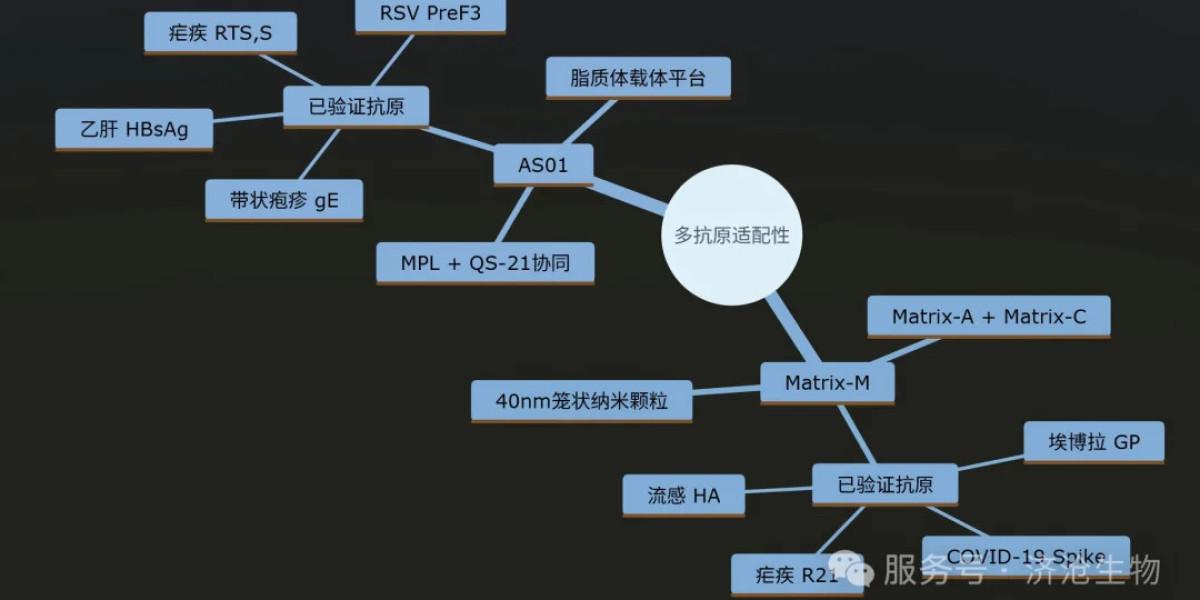
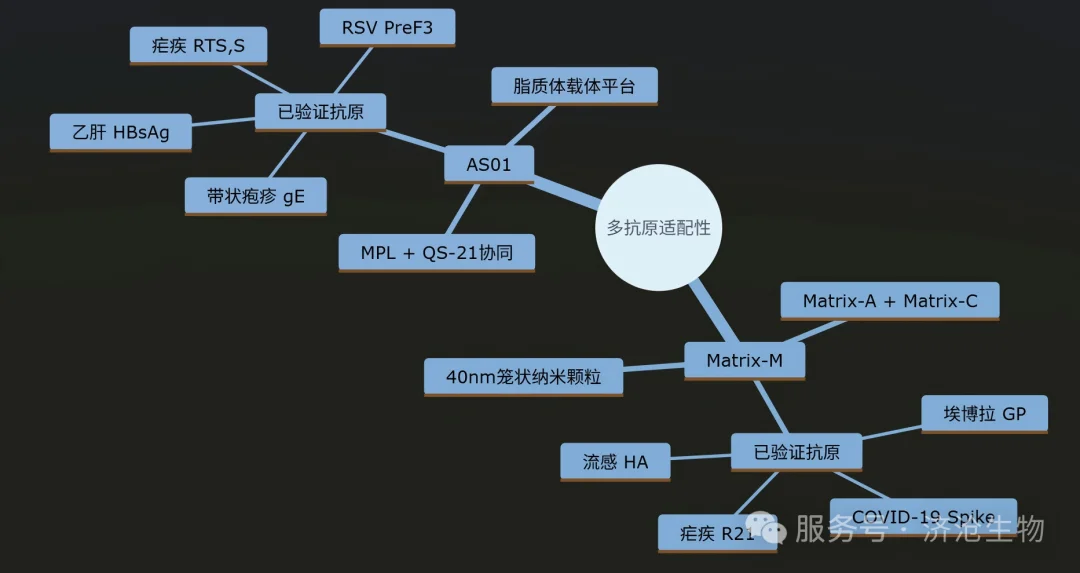
AS01 exhibits good compatibility. AS01 contains two immunostimulants: lipid A (MPL, a TLR4 ligand) and saponin QS-21. These two immunostimulants form an adjuvant system through lipids. The key to AS01's immunostimulatory mechanism is that it does not produce a specific effect by directly binding to antigens, but rather by activating innate immune pathways to "set up" the immune microenvironment—MPL activates the TLR4 signaling pathway, and QS-21 activates inflammasomes and promotes antigen cross-presentation, thus creating a synergistic effect at the cellular and molecular levels. This "platform-based" design means that AS01 can effectively enhance the immune response whether paired with malaria antigens (such as RTS,S), herpes zoster antigens (such as gE protein in Shingrix), or RSV antigens (RSVPreF3).
Matrix-M also exhibits excellent adaptability. It is composed of saponin components purified from soap trees, cholesterol, and phospholipids that self-assemble to form open cage-like nanoparticles of about 40 nm. This nanoparticle structure itself is an independent immune activation platform. It does not need to be covalently linked to antigens, but independently activates innate immune cells at the injection site and in draining lymph nodes, "setting the stage" for subsequent antigen-specific adaptive immunity. Studies have confirmed that Matrix-M can be successfully combined with Ebola virus GP nanoparticle vaccines, influenza vaccines, COVID-19 vaccines (NVX-CoV2373), and various malaria antigens.
II. Cross-Species Use
Core Question: Why are most adjuvants difficult to use across species, while AS01 and Matrix-M show potential?
Cross-species use is a core requirement of the "One Health" vaccine strategy. An ideal cross-species adjuvant needs to meet broad-spectrum safety, broad-spectrum efficacy, and antigenic synergy requirements, but achieving this faces two major obstacles: First, there are interspecies differences in innate immune receptors (such as TLRs) across different species, leading to varying activation efficiencies of the same adjuvant in different species; second, there are safety differences—for example, aluminum salts can induce sarcomas at the injection site in cats, and mineral oil emulsions are too reactive in humans.
AS01 contains MPL, a ligand for TLR4, which is an evolutionarily highly conserved innate immune receptor widely expressed in mammals; this provides the molecular basis for the cross-species application of AS01. Studies have confirmed that the AS01 adjuvant effectively enhances the immunogenicity of the RSVPreF3 vaccine in both mouse and bovine RSV infection models—in cattle pre-sensitized with prior RSV infection, the AS01 adjuvant significantly enhanced RSV-specific neutralizing antibody and T-cell responses.
The cross-species evidence for Matrix-M is even richer. Studies in specific pathogen-free (SPF) pigs have shown that Matrix-M significantly induces innate immune transcriptome responses; it also exhibits strong immunomodulatory and protective effects in a mouse Ebola vaccine model; Matrix-M is also an adjuvant component in two approved malaria vaccines (R21/Matrix-M) and a COVID-19 vaccine (NVX-CoV2373).
Matrix-M is widely used in preclinical trials of veterinary vaccines and is also widely used in finished vaccines, such as Merck's Equilis® series vaccines (equine influenza, equine tetanus, West Nile virus, etc.). A review specifically evaluating One Health's adjuvant selection listed Matrix-M as one of the most promising adjuvant candidates for cross-species application.
III. Simple Mixing for Use
Why is "ready-to-use" particularly important for veterinary vaccines?
In the veterinary field, "ready-to-use = closed-loop immunization." It moves vaccine quality control back from "farmers' hands" to "the manufacturer's production line," minimizing the risk of immunization failure due to inconsistent personnel skills or harsh environments.
AS01, as a liposomal formulation, integrates MPL and QS-21 within pre-formed liposomes. In practical use, AS01 is typically supplied as a lyophilized antigen + liquid adjuvant, requiring only simple reconstitution before vaccination. This design provides good operability under clinical conditions. The existence of different dosage variants such as AS01-B and AS01-E further increases flexibility.
The Matrix-M design also offers advantages in this regard. Its 40 nm nanoparticles are a stable aqueous suspension after preparation, requiring no complex emulsification or covalent coupling steps for mixing with the antigen. In both the NVX-CoV2373 vaccine and the R21/Matrix-M malaria vaccine, Matrix-M is used in combination with the antigen via a simple physical mixing method.
IV. Induction of Th1/Th2 Balanced Immunity
This is the core mechanistic advantage of AS01 and Matrix-M.
Traditional aluminum adjuvants primarily induce Th2-type immune responses (mainly antibodies), with limited effectiveness against pathogens requiring cellular immunity for clearance (such as intracellular parasites like viruses and protozoa). However, many important zoonotic diseases require a balanced Th1 and Th2 response to achieve effective protection.
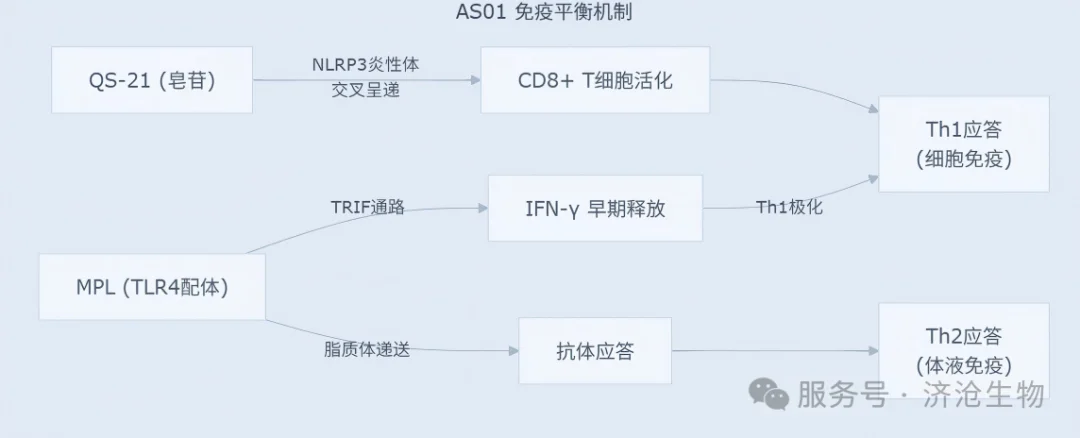
The Th1/Th2 balance mechanism of AS01:
The synergistic effect of MPL and QS-21 in AS01 is key to achieving immune balance. MPL, as a TLR4 ligand, primarily induces Th1-type cytokines such as IFN-γ through a TRIF-dependent signaling pathway; QS-21 enhances CD8+ T cell responses by promoting antigen cross-presentation and activating the NLRP3 inflammasome.
Studies have found that within hours of AS01 injection, resident immune cells at the injection site (such as NK cells and monocytes) are activated, producing large amounts of IFN-γ. This early IFN-γ response is crucial for subsequent Th1 polarization in adaptive immunity. Simultaneously, the liposome structure in AS01 effectively promotes humoral immune responses, thus achieving dual activation of Th1/Th2.
Further research has revealed that AS01 adjuvanted vaccines can induce long-term functional and epigenetic changes in the recipient's monocytes, suggesting that AS01 may also be involved in the "trained immunity" effect.
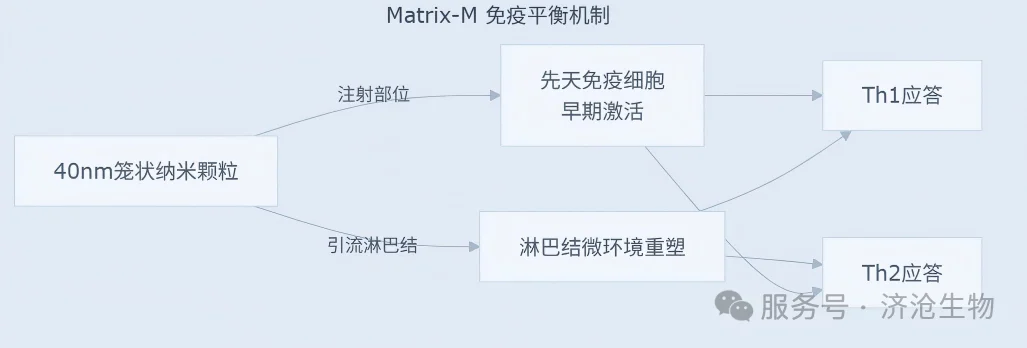
Matrix-M's Th1/Th2 Balance Mechanism:
Matrix-M initiates balanced adaptive immunity by early activation of innate immune cells at the injection site and draining lymph nodes. Transcriptome studies in SPF pigs have shown that Matrix-M simultaneously induces the upregulation of multiple pro-inflammatory and immunomodulatory genes. In Ebola virus GP nanoparticle vaccine studies, Matrix-M adjuvant enhanced antibody, cellular, and protective immune responses.
V. Existing Experience of Hundreds of Millions of Doses
Large-scale usage experience is the most important source of confidence in safety.
Regarding AS01: Vaccines containing AS01 adjuvant have been approved and administered to millions of people worldwide. Shingrix has been a recommended shingles vaccine in many countries since its launch in 2017, and the RTS,S/AS01 malaria vaccine has been undergoing large-scale pilot programs in Ghana, Kenya, and Malawi since 2019. According to incomplete statistics, the scale of AS01 usage has already reached hundreds of millions.
Regarding Matrix-M: The NVX-CoV2373 COVID-19 vaccine has received emergency use authorization or approval in many countries worldwide, with a considerable number of doses administered; the R21/Matrix-M malaria vaccine was recommended by the WHO in 2023 and will be promoted in many African countries starting in 2024; Matrix-M is the adjuvant component of these two approved human vaccines.
Equilis® Prequenza, using Matrix-M adjuvant, is one of the "gold standard" products in the global equine influenza vaccine field, maintaining a very stable market share in equine-developed countries (such as the UK, continental Europe, and North America).
VI. High Quality and Low Price
This dimension is a key consideration for the commercialization of veterinary vaccines. Chengdu Jicang Biotechnology sells both types of adjuvants at competitive prices.
AS01, developed by GSK, uses QS-21, a core ingredient extracted from soapberry bark. Its limited source and complex purification process are the main reasons why it is currently primarily used in high-value human vaccines (such as Shingrix shingles vaccine and RTS,S/AS01 malaria vaccine).
Matrix-M, developed by Novavax, also uses saponins derived from soapberries, but its nanoparticle self-assembly process is relatively standardized. However, its price limitation remains the main reason why it is currently primarily used in high-value human and high-value animal vaccines.
Jicang Biotechnology currently offers AS01 and Matrix-M-like adjuvants, with costs controlled to within 0.1 yuan/dose for commercially viable animals and within 1 yuan/dose for pets. Currently available AS01 adjuvants include two-component liposome adjuvant-B and two-component liposome adjuvant-E, while Matrix-M adjuvants include two-component nanoparticle adjuvants. Jicang Biotechnology has also added three-component formulations to these two products: three-component nanoparticle adjuvants and three-component liposome adjuvants, achieving truly high quality at a low price.
Comprehensive Assessment and Comparison
Summary Insights
From a mechanistic perspective, both AS01 and Matrix-M belong to the category of "immune environment modulation" adjuvants—their core function is not to directly carry or modify antigens, but rather to reshape the immune microenvironment at the injection site and draining lymph nodes by activating the innate immune system.
This "stage-setting" mechanism is the fundamental reason why they can achieve multi-antigen adaptation and cross-species application—because they regulate evolutionarily conserved innate immune pathways, rather than species- or antigen-specific adaptive immune pathways.
For veterinary vaccine applications, Matrix-M may have a more direct advantage in the short term: it has richer cross-species data and has been listed as a key candidate in One Health's adjuvant evaluation. AS01, on the other hand, is more mature in terms of the depth of mechanism analysis and the accumulation of clinical safety data; its MPL+QS-21 synergistic mechanism provides an important paradigm for ideal adjuvant design.
https://en.jicangbio.com/the-application-potential-of-as01-and-matrix-m-in-veterinary-vaccines.html