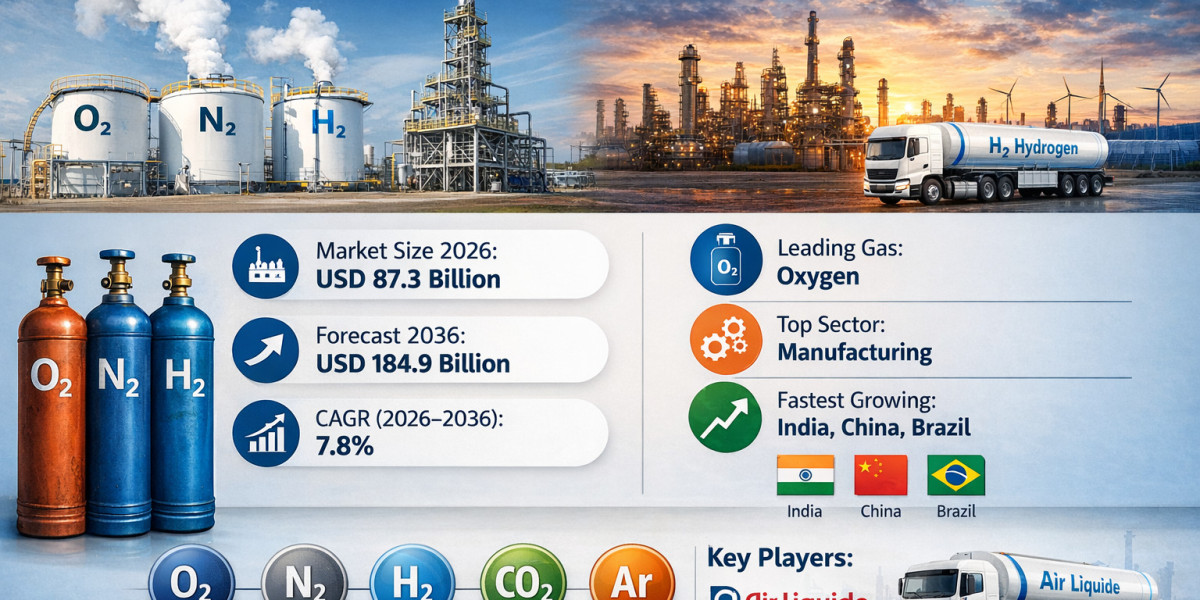

The global industrial gases market is projected to grow from USD 87.3 billion in 2026 to USD 184.9 billion by 2036, expanding at a CAGR of 7.8%. Growth reflects the essential role of oxygen, nitrogen, hydrogen, and specialty gases across manufacturing, healthcare, energy, and electronics. Demand remains closely tied to industrial output, infrastructure expansion, and long-term supply contracts rather than discretionary cycles.
Rising investments in steelmaking, chemicals, semiconductor fabrication, and clean energy systems continue to reinforce steady consumption patterns. With high capital intensity and strong process integration, the industry benefits from embedded supply relationships and infrastructure-driven demand stability.
Key Takeaways
- Market Value (2026): USD 87.3 Billion
- Forecast Value (2036): USD 184.9 Billion
- CAGR (2026–2036): 7.8%
- Leading Gas Type: Oxygen (largest share globally)
- Top Demand Sector: Manufacturing
- Fastest-Growing Countries: India (9.8%), China (8.1%), Brazil (6.0%), South Korea (5.6%), USA (5.2%)
- Supply Models: On-site generation, bulk distribution, cylinder delivery
Regional Analysis
Asia Pacific remains the primary growth engine, led by India and China. India’s 9.8% CAGR is supported by steel production, refining, infrastructure projects, and healthcare expansion. On-site gas generation is gaining preference among high-volume industrial users seeking cost stability and supply continuity.
China continues strong growth at 8.1% CAGR, driven by heavy manufacturing, electronics fabrication, and hydrogen adoption linked to cleaner industrial processes. Concentrated industrial clusters support pipeline and bulk supply models.
Latin America, particularly Brazil, shows balanced growth at 6.0%, supported by steelmaking, food processing, and mining activity.
South Korea benefits from semiconductor and electronics manufacturing, sustaining steady specialty gas demand.
The United States experiences stable expansion at 5.2%, driven by manufacturing reshoring, healthcare demand, aerospace production, and hydrogen applications in energy transition initiatives.
Market Dynamics and Growth Prospects
Industrial gases are deeply embedded within continuous industrial processes, making substitution limited. Oxygen supports steelmaking, wastewater treatment, and medical applications, while nitrogen enables inerting and preservation across manufacturing and food sectors. Hydrogen plays a growing role in refining and emerging mobility applications.
Growth is shaped by long-term supply agreements, on-site generation investments, and pipeline-linked delivery systems. High switching barriers and safety qualification requirements reinforce supplier-customer integration.
Request a free Sample Report - https://www.futuremarketinsights.com/reports/sample/rep-gb-15908
Innovation and Emerging Technologies
Technological advancements are transforming production efficiency and environmental performance. Energy-efficient air separation units, carbon capture integration, and digital process optimization are enhancing cost control and reliability.
Hydrogen innovation is accelerating, particularly in blue and green hydrogen development. Renewable-powered electrolysis is gaining momentum in regions pursuing energy transition targets. Specialty gas mixtures designed for semiconductor and pharmaceutical applications require ultra-high purity and contamination control, increasing demand for advanced purification technologies.
Leading and Emerging Players Driving Competition
The competitive landscape remains consolidated, dominated by multinational industrial gas providers with global production networks and long-term client relationships. Key players include:
- Air Liquide
- Linde plc
- Air Products and Chemicals
- Messer Group
- Taiyo Nippon Sanso Corporation
Report Coverage & Deliverables
This report provides detailed quantitative analysis in USD billion across gas types, end-use industries, and distribution modes. Coverage includes oxygen, nitrogen, hydrogen, carbon dioxide, argon, and specialty gases. End-use segmentation spans manufacturing, chemicals & energy, metallurgy & glass, healthcare, food & beverages, and electronics.
The study evaluates on-site, bulk, and cylinder distribution models across Asia Pacific, Europe, North America, Latin America, and the Middle East & Africa, with country-level insights for India, China, Brazil, South Korea, USA, and 40+ additional markets.
Future Outlook
Through 2036, industrial gases will remain indispensable to global production ecosystems. Expansion will align with manufacturing output, infrastructure development, and clean energy transitions. Hydrogen adoption, digitalization of supply systems, and investments in low-emission production technologies are expected to shape the next decade.
Embedded supply relationships, high capital barriers, and safety-critical integration will continue to stabilize demand visibility. The market’s trajectory reflects structural industrial dependence rather than cyclical consumption patterns, supporting sustained long-term value expansion.
Request Sample Report with Complete Market Breakdowns and Growth Estimates:
https://www.futuremarketinsights.com/reports/industrial-gases-market
Have a specific Requirements and Need Assistant on Report Pricing or Limited Budget please contact us – sales@futuremarketinsights.com
About Future Market Insights (FMI)
Future Market Insights, Inc. (FMI) is an ESOMAR-certified, ISO 9001:2015 market research and consulting organization, trusted by Fortune 500 clients and global enterprises. With operations in the U.S., UK, India, and Dubai, FMI provides data-backed insights and strategic intelligence across 30+ industries and 1200 markets worldwide.
Why Choose FMI: https://www.futuremarketinsights.com/why-fmi